Halloween Room: Sinister Tales



500K+
Installs
HFG Entertainments
Developer
-
Casual
Category
-
Teen
Content Rating
-
https://www.hfgentertainments.com/AppPrivacyPolicy.html
Privacy Policy
editor reviews
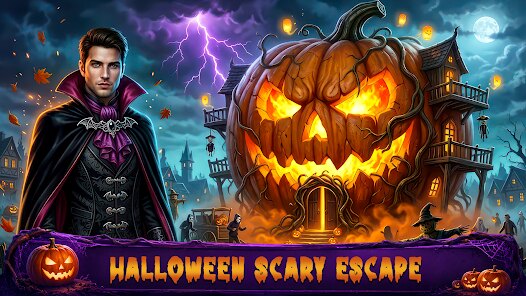
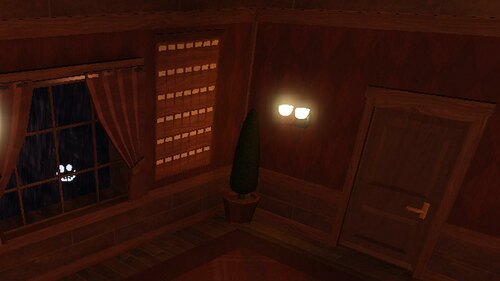
Halloween Room: Sinister Tales isn't your typical jump-scare fest. It's a narrative-driven puzzle adventure that leans heavily into atmospheric dread and slow-burn storytelling, wrapped in a point-and-click shell that feels both nostalgic and refreshingly modern. At its core, you're navigating a series of haunted vignettes—each a self-contained "room" with its own twisted tale—solving environmental puzzles to unravel a larger, interconnected mystery. It belongs to that niche space where adventure game veterans and horror enthusiasts who prefer cerebral chills over gore collide. Honestly, I first clicked on it because of the striking, hand-painted art style that popped up on my feed; the muted, candle-lit palettes and distorted perspectives hinted at something more artistic than the typical asset-flip horror, and that initial intrigue is what pulled me through the door.
My first hour was deceptive. The controls are simple—click to move, interact, and combine items—but the learning curve isn't about mechanics. It's about unlearning the urge to rush. I remember getting stuck in the second "Sinister Tale," a decrepit Victorian parlor, for a solid twenty minutes, convinced I'd missed a hidden trigger. Turns out, the solution required me to interpret a child's crayon drawing as a map, which then aligned with a pattern of scratches on a floorboard. That moment of sudden clarity was electric. The game's pacing is a slow, deliberate crawl, and the absence of a traditional HUD keeps you completely immersed. There were times the UI felt a touch too minimalist, though—I accidentally skipped a crucial diary entry because the text prompt blended into the background—but that minor frustration was outweighed by the consistent, oppressive atmosphere and a surprisingly stable performance, even on my mid-range laptop. I found myself playing with headphones and lights off, and the creaking ambience genuinely got under my skin.
Why did I stick with this instead of the other horror titles I've reviewed? It's the restraint. So many games in this genre rely on cheap jump scares or oppressive combat to create tension. Sinister Tales trusts its writing and environmental storytelling. Each puzzle feels like a piece of a character's psyche, not just a lock to pick. Compared to similar indie titles like "Fran Bow" or "Detention," this one does a better job of making you feel like a silent observer piecing together a tragedy rather than a participant who is being hunted. The reward isn't a bigger gun or a stat increase; it's a more complete understanding of the sorrowful lore. That unique payoff—intellectual and emotional rather than mechanical—is what kept me returning to unravel the next tale. It won't appeal to everyone; action-driven players will likely find it tedious. But for those who appreciate narrative texture over twitch reflexes, it's a haunting gem.
features
- 🔍 Contextual Interaction System: Instead of generic "Examine" prompts, the game uses a context-sensitive cursor that changes based on your proximity and the object's relevance. For example, hovering a family portrait might show a magnifying glass, but turn it over and the icon shifts to a hand, indicating a hidden compartment. This subtle feedback loop encourages meticulous scanning without breaking your focus on the narrative.
- 📜 Episodic Chapter Structure: The game is divided into four distinct "Tail Tales," each lasting about 1.5 to 2 hours. Each episode is self-contained with its own setting and puzzle logic, but items and visual motifs carry over, creating a subtle, interconnected lore that rewards careful attention. Episodes are selectable from a main menu, allowing for easy replay without a linear storyline penalty.
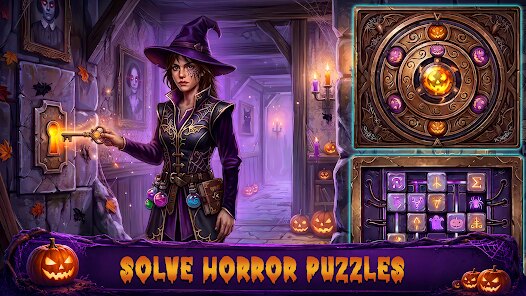
- 🎨 Environmental Puzzle Design: All puzzles are integrated into the scenery, using logical rules from the era or setting. For instance, you might align a clock based on a hidden clue in a letter or rearrange tarot cards on a table to match a series of ghostly whispers. There are no inventory-box conundrums; instead, puzzles manipulate the world directly, which feels immersive and physically grounded.
- 🔊 Binaural Audio Cues: The game heavily utilizes 3D spatial audio for critical hints and story beats. A character's sob might come from your left, guiding you to a relevant object, while a chair creaking behind you signals an unseen presence. This auditory layer is a functional tool, not just an ambient garnish, helping you navigate dark scenes and locate interactive elements off-screen.
- 🚪 Permadeath-Off Exploration Mode: While the primary mode has irreversible consequences for certain narrative choices, the developers included a "Curator Mode" in the settings. This disable all failure states, letting you explore freely without resetting puzzles, which is perfect for players who prioritize story over challenge or want to replay for missed details without anxiety.
pros
- 🧠 Cerebral Storytelling Genius: The narrative is a web of subtlety. It never spoon-feeds you exposition; instead, facts are presented through a murder of crows, a dripping tap, or a torn page. Piecing together the "sinister tale" behind each room felt like being a detective in a dream, and the eureka moments are deeply satisfying because you've earned the context.
- 🎨 Hand-Painted Visual Dread: The art direction is a masterpiece of mood. Every brushstroke seems calculated to induce unease—warped perspective and unsettling color shifts in shadows create a sense of impending wrongness. It's beautiful in a malicious way, and it makes simple exploration feel like walking through a living painting.
- 🐢 Patient, Punishing-Free Pacing: This game respects your intelligence. It never rushes you, and the absence of enemies or time limits removes the fear of failure, replacing it with pure, intellectual curiosity. You're free to retreat, reassess, and revisit locations, which builds a comfortable rhythm that heightens the eventual shock of a revelation.
- 🎻 Emotional Soundtrack That Hums Underneath: The music is sparse but precise. A melancholic piano leitmotif might fade out just as you realize the truth about a ghost's identity, leaving you in stark silence that amplifies your emotional reaction. It knows exactly when to whisper, when to swell, and when to vanish entirely.
cons
- 🕹️ Frustrating Cursor Precision: There were several instances where the interaction icon wouldn't register on a small, crucial object—like a needle or a keyhole—forcing me to wiggle my mouse across the exact pixel until it triggered. This technical friction broke immersion during otherwise tense moments and felt more like a glitch than a deliberate challenge.
- 📝 Minimal Text Truncation: The diary and clue text lack a proper text-skip feature that respects pacing. You can only page forward, not backward, and the background is often busy, making the font hard to read in low-light scenes. I twice missed important lore details because I accidentally clicked forward, wasting a few minutes of backtracking.
- 🔁 Episodic Pacing Inconsistency: While the chapter structure is neat, the first tale is significantly shorter and simpler than the third, creating an uneven difficulty spike. By the time I reached the fourth chapter, I felt fatigued by the puzzle complexity, whereas the opening felt almost like a glorified tutorial. This inconsistency might frustrate players who prefer a steady ramp.
- 💻 No Controller Support for Menu Navigation: The game supports controllers for movement and interaction, but you must use your mouse to navigate the inventory and options screens. This forced hybrid control scheme is clunky on a couch setup and feels like an oversight for a title that begs to be played in the dark on a big screen.
Articles
![]()
How to Get Robux Safely Without Scams
![]()
How to Download Older Versions of Android Apps
![]()
How to Download Games on Google Play for the First Time
![]()
What Is an APK File for Android? Everything You Need to Know
![]()
Do Free Robux Generators Work?
![]()
Robux Pricing Guide (2026 Update): How Much Robux Really Costs
![]()
How to Avoid Scams in Roblox
![]()
Rarest Pets in Adopt Me! (2026 Update)
![]()
How to Trade Safely in Adopt Me! (So You Don't Lose Everything)
![]()
Secret Tricks Nobody Tells You in 'Steal a Brainrot'
![]()
Beginner Guide: Don't Lose Your Brainrot
![]()
How to Steal in 'Steal a Brainrot' Without Getting Caught (Or at Least Not Instantly)
![]()
Is Brookhaven RP Worth Playing? It Depends on What You’re Looking For
![]()
Why Blox Fruits Is So Popular? Here’s Why Everyone Keeps Playing It
![]()
Best Roblox Obby Games for Beginners (2026): Learn the Game Without Hitting a Wall
![]()
Top 10 Roblox Horror Games (2026): The Scariest Experiences You Can't Miss










Hot Apps
-
![]()
Direct Express®
i2c Inc.4.3
-
![]()
Telegram
Telegram FZ-LLC4.2 -
![]()
Cash App
Block, Inc.4.5
-
![]()
Duolingo: Language & Chess
Duolingo4.7 -
![]()
Google Maps
Google LLC4.2 -
![]()
ParkMobile: Park. Pay. Go.
Parkmobile, LLC4.3 -
![]()
Amazon Fire TV
Amazon Mobile LLC4.1 -
![]()
Yuka - Food & cosmetic scan
Yuka App4.7 -
![]()
GroupMe
GroupMe4.5 -
![]()
Geeni
Merkury Innovations4.6 -
![]()
Venmo
PayPal, Inc.4.2 -
![]()
CapCut - Video Editor
Bytedance Pte. Ltd.4 -
![]()
PolyBuzz: Chat with AI Friends
CLOUD WHALE INTERACTIVE TECHNOLOGY LLC.3.8 -
![]()
Microsoft Copilot
Microsoft Corporation4.8 -
![]()
Ford™
Ford Motor Co.4.7 -
![]()
OfferUp: Buy. Sell. Letgo.
OfferUp Inc.4.4 -
![]()
Sora by OpenAI
OpenAI4.7 -
![]()
YouTube
Google LLC4.1 -
![]()
Facebook
Meta Platforms, Inc.4 -
![]()
Spotify: Music and Podcasts
Spotify AB4.3 -
![]()
Google Chat
Google LLC4.4 -
![]()
Wise: International Transfers
Wise Payments Ltd.4.7 -
![]()
Google Pay
Google LLC4.4 -
![]()
PayByPhone
PayByPhone Technologies Inc .4.9 -
![]()
Netflix
Netflix, Inc.3.9 -
![]()
Grok
xAI4.9 -
![]()
Chai: Chat AI Platform
Chai Research Corp.4.4 -
![]()
Waze Navigation & Live Traffic
Waze3.9 -
![]()
Afterpay - Buy Now Pay Later
Afterpay3.8 -
![]()
Snapchat
Snap Inc4.1






























Disclaimer
1.Appinfocenter does not represent any developer, nor is it the developer of any App or game.
2.Appinfocenter provide custom reviews of Apps written by our own reviewers, and detailed information of these Apps, such as developer contacts, ratings and screenshots.
3. All trademarks, registered trademarks, brand names and company names or logos appearing on the site are the property of their respective owners.
4.Appinfocenter abides by the federal Digital Millennium Copyright Act (DMCA) by responding to notices of alleged infringement that complies with the DMCA and other applicable laws.
5.If you are the owner or copyright representative and want to delete your information, please contact us [email protected].
6.All the information on this website is strictly observed all the terms and conditions of Google Ads Advertising policies and Google Unwanted Software policy.
7.Appinfocenter.com is an independent, information-only website which is 100% free to all the users.